The New SEO Battle: How to Get Your Content Selected by AI

Getting content noticed has always been a moving target, but the rules of engagement are shifting again. Ranking at the top of a search results page used to be the final goal. Today, with platforms like ChatGPT, Perplexity, and Google’s AI responses answering questions directly, visibility means something new: being chosen as a source.
Your brand is no longer competing only for rankings. It is competing to be selected as a source, included in a summary, or mentioned in a recommendation. A page may rank well but still be overlooked by AI if it lacks clear context, evidence, or clear structure an AI needs to cite it confidently.
To stay visible, search strategy is expanding into four connected approaches: traditional SEO, GEO (Generative Engine Optimization), AEO (Answer Engine Optimization), and LLM SEO. Each plays a different role in helping content get found, understood, selected, and presented to users.
Here is how they actually work together, and how to make sure AI platforms select your content.
Answer Engine Optimization (AEO): Becoming the Direct Answer
AEO focuses on giving users immediate, factual answers to specific questions.
Rather than focusing solely on ranking an entire page, AEO structures key sections so search engines, voice assistants, and AI tools can easily extract direct answers. A strong AEO response is concise, factual, clearly formatted, and addresses the question in the first sentence. This helps your brand gain visibility when users are looking for quick, reliable information.
A strong AEO answer is typically:
Direct
Factual
Easy to understand
Clearly formatted
Closely aligned with the user’s question
For example, a page might include the heading, “What Is Answer Engine Optimization?” followed immediately by a concise definition:
“Answer Engine Optimization (AEO) is the practice of structuring content so search engines, AI platforms, and voice assistants can instantly extract a concise, direct answer to a specific user question.”
The rest of the section can then provide more detail.
This question-and-answer structure serves users who want information quickly while allowing those seeking a deeper explanation to continue reading.
Measuring Visibility Beyond the Click
AEO shifts part of the marketer’s focus from earning a click to becoming the source of the answer. As a result, success metrics must also evolve. Rankings and website traffic still matter, but they no longer provide a complete picture. Marketers should also track whether their content is being surfaced, cited, or mentioned in AI-generated responses, even when the interaction does not lead to an immediate website visit.
Generative Engine Optimization (GEO): Earning AI Recommendations
Generative Engine Optimization (GEO) focuses on optimizing content for AI-powered platforms such as ChatGPT, Claude, and Perplexity. Its goal is to increase the likelihood that content will be referenced or included in AI-generated answers, summaries, and recommendations.
GEO focuses on helping AI systems interpret the relevance, context, and credibility of content:
What the content is about
Who the content is intended to help
What problems it addresses
Why the source is credible
How the information relates to the user’s question
For instance, a footwear brand could create separate pages targeting phrases such as “soft shoes for foot pain,” “comfortable shoes for sensitive feet,” or “cushioned everyday shoes”
A GEO strategy goes deeper. The content explains how specific sole structures, arch supports, and cushioning materials address distinct podiatry conditions, walking surfaces, or body types. That added context helps AI platforms understand when and why a particular product may be relevant, increasing its usefulness in a recommendation.
GEO in Practice: An Online Therapy Platform
A therapy platform could target general keywords such as “online therapy” or “mental health counseling.” However, those phrases alone may not provide enough context for an AI system to understand the platform’s expertise or suitability.
A stronger GEO strategy would include content explaining:
The types of therapy available
The qualifications of the therapists
The conditions each therapy may support
When online therapy may be appropriate
How online sessions compare with in-person care
What a patient can expect from a first appointment
The platform might publish an article titled: “How Cognitive Behavioral Therapy Helps Young Adults Manage Anxiety”
Supported by clinical research, qualified expert input, transparent sourcing, and clearly explained use cases, the article must give AI systems stronger signals of relevance and credibility. When a user asks about safe and reliable mental health options, the AI has a strong basis for citing the platform.
LLM SEO: Making Content Easy for Machines to Understand
LLM SEO focuses on making content structurally and semantically clear to AI systems, while GEO focuses on increasing its usefulness and relevance within AI-generated answers and recommendations.
LLM SEO builds on many established SEO practices, including clear content structure, topical depth, internal linking, and authoritative information. What changes is the objective. LLM SEO aims to make content easy for large language models to understand, extract, and summarize without being hindered by unclear language, inconsistent structure, or complex formatting.
Effective LLM SEO includes:
Logical heading hierarchies: Organizing content in a clear structural flow
Entity relationships: Explicitly connecting topics, products, authors, organizations, and related concepts within the content
Clear schema markup: Using structured data, such as JSON-LD, to help search engines and other systems interpret the page accurately
Topical clustering: Interlinking related articles to demonstrate comprehensive coverage of a subject
What Is Traditional SEO?
Traditional SEO focuses on helping webpages rank higher in search engine results. It commonly involves identifying relevant keywords, optimizing titles and page content, building internal and external links, and improving website structure, all aimed at earning visibility and clicks.
Those fundamentals still matter; they remain the foundation of web discovery. However, in an AI-powered search landscape, keywords alone are no longer enough. Your content must also provide the context, clarity, and credibility AI systems need to understand its value and determine why they should use your information.
How Traditional SEO and LLM SEO Differ
Consider a travel company creating a guide about the best time to visit Japan.
Traditional SEO approach
The page may target keywords such as: “Best time to visit Japan”; “Japan weather by month”; “When to travel to Japan”
The title, headings, internal links, images, and metadata would be optimized around those search terms. Main objective: Rank in search results and attract the click.
LLM SEO approach
The page would still use relevant keywords, but it would organize the information so AI systems can easily understand, compare, and use it in their answers.
For example, it could explain:
Which months are best for cherry blossoms, autumn colors, skiing, or fewer crowds
How weather conditions differ between Tokyo, Kyoto, Hokkaido, and Okinawa
Which season is best for families, budget travelers, or first-time visitors
The advantages and disadvantages of visiting during each season
What official tourism data, weather information, or local sources support the recommendations
The goal is not only to rank, but also to become a useful source that an AI platform can confidently include in a travel recommendation.
How GEO and LLM SEO Work Together
GEO and LLM SEO are also closely related, but they emphasize different parts of AI visibility.
Think of their relationship like this:
LLM SEO focuses more specifically on how content is structured, explained and supported so that large language models can understand and use it effectively.
GEO focuses on optimizing content for generative search experiences. It aims to make the content useful for AI-generated summaries, recommendations and responses.
In the travel example above, LLM SEO would organize the information into clear sections covering seasons, regions, weather, costs, activities, and traveler types. This helps AI systems identify and compare the relationships between the information.
GEO would use that structured information to explain:
Which season is best for families, budget travelers, or skiers
The advantages and disadvantages of each season
How recommendations change depending on the traveler’s priorities
What evidence supports each recommendation
In practice, many of the same improvements support both: LLM SEO helps AI understand the information, while GEO makes that information useful enough to include in an answer or recommendation.
SEO, AEO, GEO, and LLM SEO Compared
| Main Focus | How Content Is Optimized | Typical Outcome |
SEO Traditional search engine results | Page rankings & website traffic | Keyword targeting, page structure, technical performance, backlinks | Higher SERP positions & direct clicks |
AEO Direct Answer Engines & Voice | Extractable, concise facts | Question-based headers, direct opening definitions, clean formatting. | Featured snippets, voice responses, zero-click answers |
GEO Generative Search Platforms | Inclusion in AI summaries & suggestions | Contextual depth, multi-angle comparisons, expert citations, trust signals | Brand mentions & recommendations in AI responses |
LLM SEO Large Language Models and AI Systems | Data architecture & concept mapping | Entity mapping, clear heading hierarchies, schema markup, topical depth | Easier machine interpretation and stronger relevance signals. |
How SEO, GEO, AEO and LLM SEO Work Together
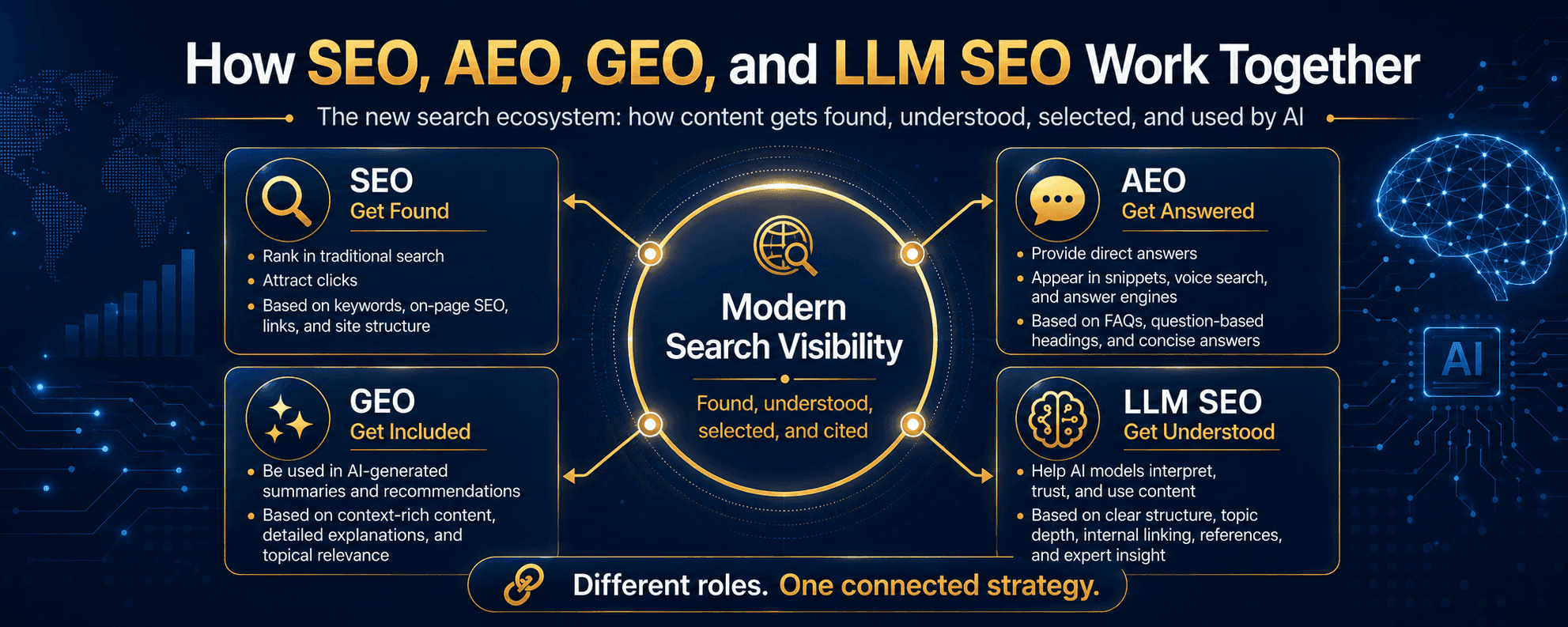
These four approaches are not replacements for one another; they are interconnected layers of a modern content strategy.
To create an article that performs across traditional search and AI platforms, use this simple structural blueprint:
Start with a direct summary: Answer the core question immediately in 1–2 sentences (primarily for AEO)
Provide detailed context: Explain the subject deeply, covering specific use cases, body types, or edge cases (primarily for GEO)
Use clear structural markup: Organize with logical H2/H3 headings and structured schema (for traditional SEO & LLM SEO)
Include real evidence: Add expert quotes, clinical studies, or first-party data to establish authority (for GEO & LLM SEO)
Add an FAQ section: Answer related long-tail questions in clean Q&A formats (for AEO & LLM SEO)
Maintain strong internal links: Connect the piece to other relevant pages on your site (primarily for SEO)
Conclusion
Modern search is no longer limited to rankings and clicks. Brands need to consider whether their content can be understood, summarized, quoted or recommended by AI systems. The most effective strategy is not to abandon SEO. It is to expand it.
The brands that succeed will be those that create content for people first while making the information easy for AI systems to interpret and reuse.
Share on LinkedIn