AI Is Telling Your Brand’s Story. With or Without You.

A potential customer can easily form an opinion about your brand without ever reading a word on your website content. When they ask an AI assistant about your business or how it compares with competitors, the answer may draw on your content, customer reviews, and what others have published about you. That story could miss what makes your business worth choosing.
Building a Clearer Brand for Search and AI
Do you know how AI presents your brand? And does your content give it a clear account to work with?
The answer starts with the information you control. AI does not see your brand the way your marketing team does; it sees pages, mentions, reviews, experts, products, and evidence scattered across the web.
The challenge is making those pieces add up to the same picture. A product page may explain features, a case study may prove results, and an expert article may demonstrate authority, but unless the relationships are clear, that context can get lost.
This means examining how the brand is represented in the wild, whether it appears in relevant AI-generated answers, which sources are cited, and whether its products, services, and expertise are described accurately and consistently.
For SEO, this increasingly means building a coherent understanding of the brand across search and AI systems, rather than simply optimizing individual pages or articles in isolation.
That brings us to three core areas that need to be embedded across your strategy, end-to-end processes, and cross-functional collaboration: content structure, entity modelling, and GEO.
Structure Content Around Meaning
Structured content organizes information so its context, meaning, and relationships are instantly clear to both humans and machines. This includes clear headings, consistent terminology, direct answers to specific questions, and logical connections between related pages and topics.
Consider a software company that describes its product as “easy to implement.” A prospective customer still needs to understand what implementation involves, who needs to participate, what prerequisites exist, and what could cause delays.
A high-performing page that presents these points sequentially, outlines the setup steps, lists the prerequisites, and links directly to a case study demonstrating the process in practice.
The goal is not simply to make a page easier to read. It is to make the meaning behind the content easier to understand and connect.

Core Principles for Structuring Content
Information Hierarchy: Use headings and subheadings that mirror user questions, ordering information logically from foundational concepts to more specific details.
What does someone need to understand first before the rest of the page makes sense?
Contextual Relationships: Build clear connections between related topics, products, examples, evidence, and pages.
If someone encounters only one part of our content, will they still understand what we mean?
Explicit Answers: Provide self-contained answers that resolve questions directly, without forcing readers or AI models to infer meaning.
Does the answer resolve the question, or does the customer still need more information to understand it?
Getting these elements right gives marketing teams a practical framework for identifying vague descriptions, disconnected evidence, and contradictory product details.
Entity modelling
Connect Your Brand to Its Products and Expertise
Search and AI systems need to understand not only what your products, people, services, and topics are, but also how they relate to and connect with one another.
Entity modelling makes these relationships explicit by identifying the core entities around your brand, such as people, products, organizations, services, places, and concepts, and mapping how they interact and relate to one another. The entities are the individual elements, while the modelling defines the structure of the relationships between them.
For a company, this might mean connecting a product to its capabilities, the customers it serves, the problems it solves, the experts behind it, and the evidence supporting its claims. For example:
Brand → offers → Product
Product → has → Capability
Product → serves → Customer type
Expert → specializes in → Topic
Case study → demonstrates → Product use case
Core Principles of Entity Modelling
Look Beyond Keywords: Identify the people, products, and concepts search terms along with the relationships that give them meaning.
Make Connections Explicit: Clearly state how products, services, experts, and audiences relate to one another.
Maintain Consistency: Use consistent naming and entity definitions across pages, while allowing the language to suit each audience and context.
Reduce Ambiguity: Provide enough detail to distinguish similar products, separate features from services, and make clear who offers what.
Entity modelling provides a framework for organizing content and identifying gaps, inconsistencies, or contradictory information.
Reinforce Entity Relationships with Structured Data
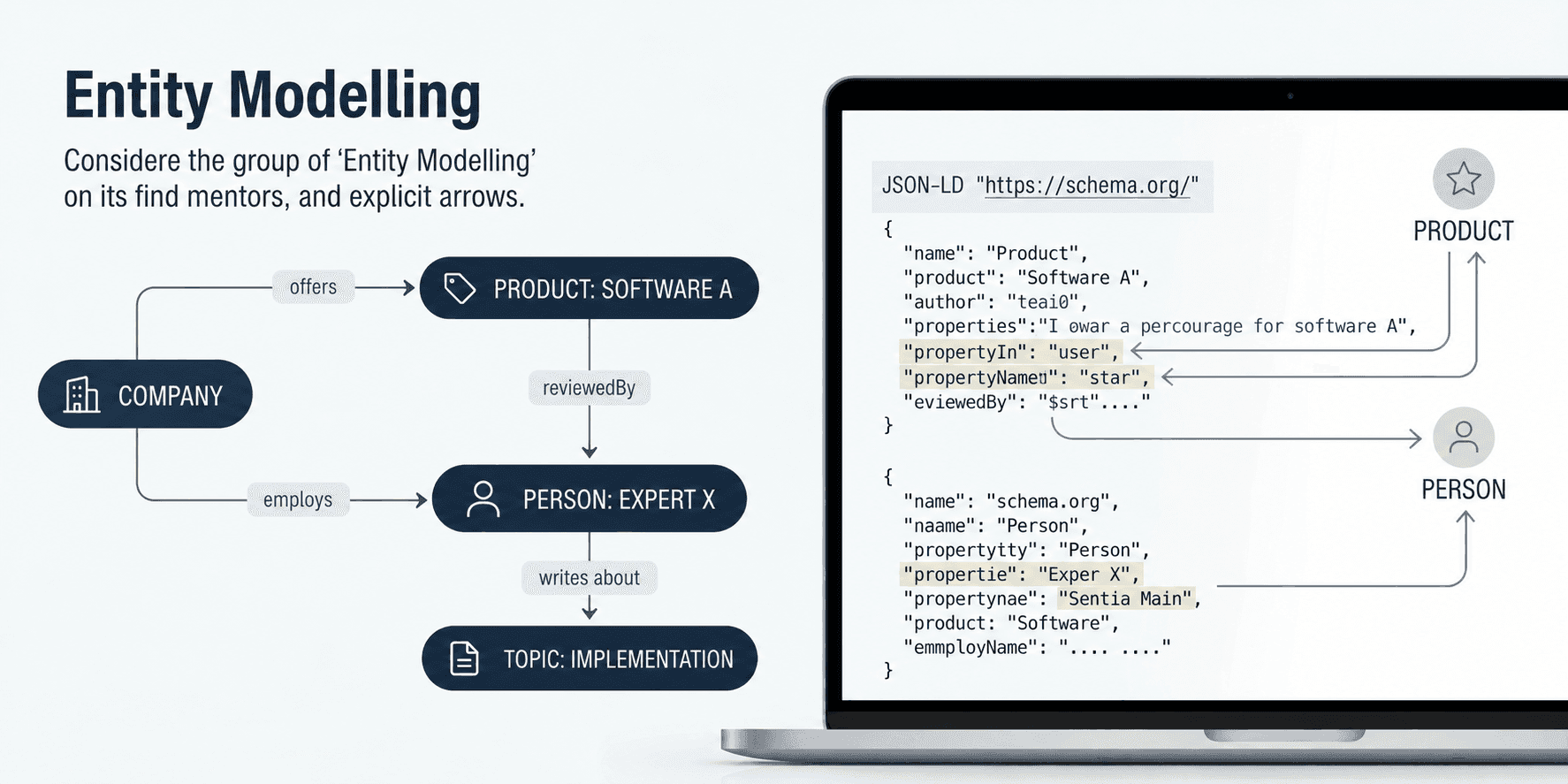
Once those entities and relationships are clearly defined in your content, structured data provides a technical layer that helps search engines interpret them more precisely.
Using Schema.org vocabulary with JSON-LD, you can label key elements such as your organization, products, people, reviews, and articles in a machine-readable format.
This does not replace the information on the page. It reinforces it by giving search systems a clearer technical description of what each element represents.
Generative Engine Optimization (GEO)
Improve How Your Brand Appears in Generative Search
Clear content and well-defined entity relationships help explain your brand. Generative engine optimization (GEO) focuses on improving its visibility in AI-generated search experiences (such as ChatGPT, Perplexity, and Google AI Overviews).
When potential customers ask questions about your category,
Does your brand appear?
Which sources are cited?
Does the answer explain your products, expertise, and positioning correctly?

Core Principles for GEO
Visibility: Does your brand make the shortlist? Try questions your customers ask when comparing options. Notice when competitors appear and whether your brand is included.
Citation: Who is telling your story? Is AI pointing customers to your current product page, an old review, or someone else’s description of your business?
Representation: Are key purchase details accurate? Verify the information that may affect a buying decision, including capabilities, target customers, availability, and limitations.
Supporting Evidence—Can you back up what makes you different? If you promise faster implementation, show the process and a documented customer result. Give people evidence they can assess.
Final thoughts
The fundamental paradigm shift is clear: your website is no longer just a destination for human users.
Today, search engines and AI models act as proxy storytellers for your business, deciding how your capabilities, expertise, and value are framed to the world.
While marketers cannot control every generative response, they can control the quality of the signals they feed into these systems. By structuring content clearly, defining entity relationships, and monitoring GEO performance, you build a coherent body of information that gives search and AI systems an accurate account of your brand.
Share on LinkedIn