How AI Is Redefining User Intent
AI is redefining user intent and changing how search engines evaluate content. This article explains the new intent landscape, why intent now matters more than volume, and how to adapt your SEO strategy accordingly.
How AI Is Redefining User Intent
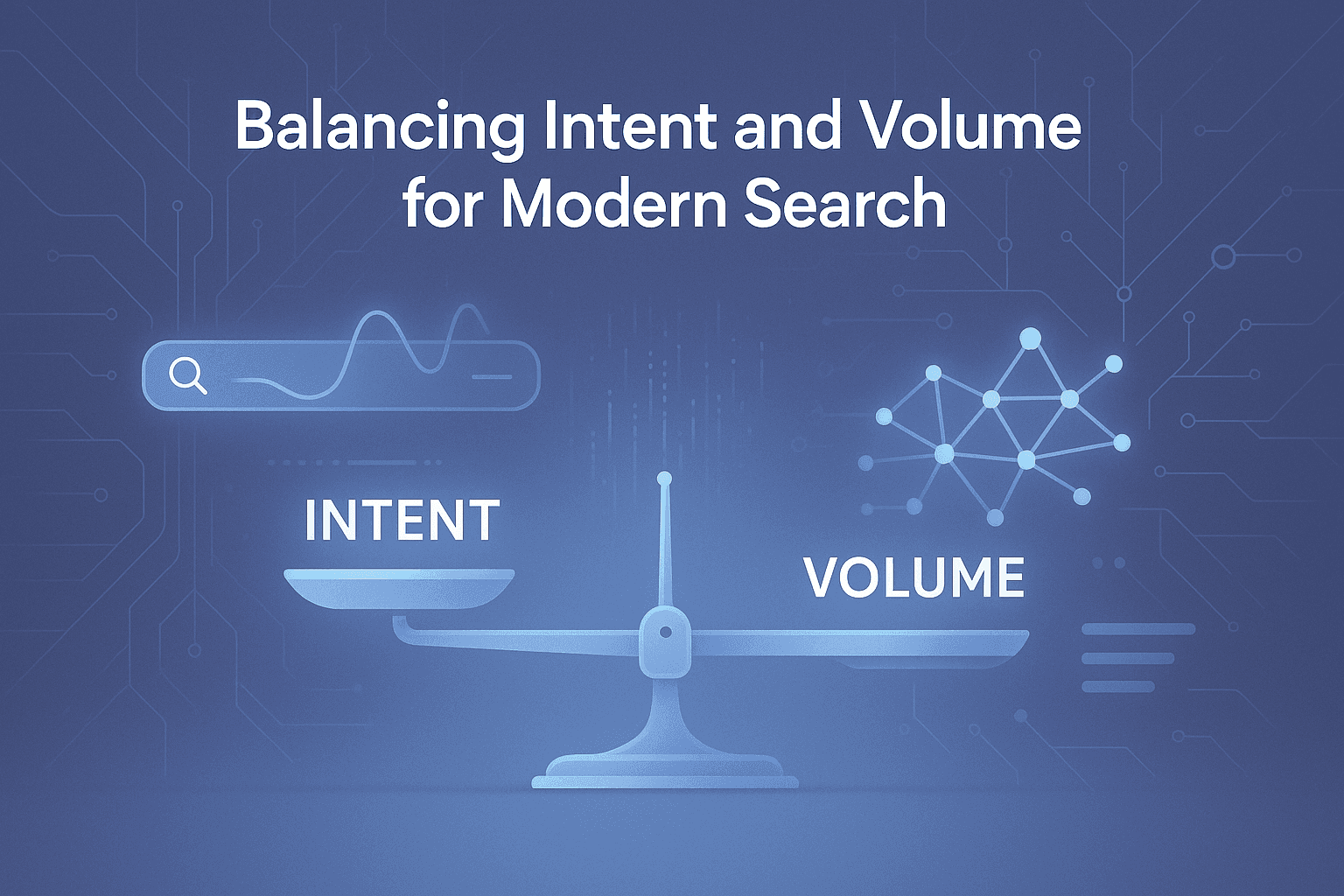
Balancing Intent and Volume for Modern Search
For years, SEO revolved around keyword volume. A high-volume keyword, perhaps 20k monthly searches, was the undisputed north star, often deemed a superior opportunity compared to one with just 50.
However, as search algorithms have grown more sophisticated and user behavior has become more nuanced, this foundational thinking is rapidly evolving.
Volume, Informed by Intent
Today, intent overrides volume. Search engines prioritize content that aligns with what the user is trying to accomplish. The purpose behind the query now shapes visibility more than the raw number of searches.
From my experience in marketing leadership roles, I’ve consistently seen content intent misunderstood or overlooked. For years, I’ve advocated for assigning a clear intent to every piece of content. That discipline, understanding what the user needs in their exact moment, has become the true driver of sustainable organic growth.
The Shift: How AI Is Redefining Search Intent & Strategy
For years, SEO professionals defined intent using a linear funnel model to define and categorize user intent:
TOFU (Top of Funnel): Users seeking general information or learning (e.g. “What is AI SEO?”).
MOFU (Middle of Funnel): Users comparing solutions or options (e.g. “Best AI SEO tools”).
BOFU (Bottom of Funnel): Users ready to act or buy (e.g. “Buy AI SEO software”).
This static framework worked when search was primarily keyword-based. But the rise of Generative AI and advanced machine learning has fundamentally changed how intent is interpreted. We now need to shift from simply categorizing intent to dynamically fulfilling it.
AI-Driven Shifts That Changed Traditional Intent Modeling
Today, AI interprets intent dynamically, blending semantics, user behavior, and context to understand why users search, not just what they search for.
1. From Lexical Matching to Semantic Understanding
Traditional SEO:
Search engines matched content based on keywords and simple NLP techniques like stemming or synonym lists, to improve matching. But results still leaned heavily on keyword proximity and density.
The AI Shift:
Today’s AI-enhanced search engines use advanced language models with sophisticated contextual understanding. Instead of relying on words, they interpret meaning through context and concept relationships.
Example:
When someone searches for “AI tools for SEO writers”, AI understands they’re looking for writing-optimized solutions, even though the work “solutions” never appears in the query.
From Single-Intent Queries to Multi-Layered Intent
Traditional SEO:
Queries were classified into one intent type, informational, navigational, or transactional, with little room for nuance.
The AI Shift:
AI now understands that a single query can express several intents at once. Users often explore, compare, and evaluate solutions within the same search.
Example:
A query like “best AI SEO tools for beginners” carries layered intent. The user wants to learn what tools exist (informational) but they are also evaluating options and potentially choose one (transactional). Classic funnel models treat these as separate stages, but AI sees them as blended.
3. From Static Categorization to Contextual Personalization
Traditional SEO:
Two people searching for the same phrase would see nearly identical results, regardless of their background or intent.
The AI Shift:
AI now considers contextual signals, such as device type, location, and recent search behavior, to adjust results.
Example:
A search for “AI keyword tools” may surface quick, easy-to-read summaries on mobile, more detailed comparison guides on desktop, or beginner-friendly content if the user’s recent searches suggest they’re new to SEO.
4. From Reactive Discovery to Predictive Guidance
Traditional SEO:
We analyzed historical keyword data to react to what users had searched for.
The AI Shift:
Large Language Models analyze patterns to anticipate intent, predicting what users will likely need next. Intent is no longer something users merely reveal; it's something AI infers before they ask.
Example:
AI may detect that users researching “AI SEO basics” often go on to explore “AI workflow automation.” Even if that second query hasn’t spiked yet, AI can predict the next intent step.
Intent as a Dynamic System, not a Linear Path
While TOFU, MOFU, and BOFU still matter for internal planning, AI-driven intent is fluid, contextual, and non-linear. To stay competitive, SEO leaders must combine traditional funnel logic with AI-powered intent modeling.
A multiple-intent cluster supports this shift. It’s a content framework where a broad topic is covered through a connected set of pages, each intentionally designed to meet different layers of user intent, from exploration to evaluation to action, all within the same topic ecosystem.
(Contextual Intent × Semantic Understanding) × Volume
Contextual intent tells you what the user is trying to accomplish in their situation.
Semantic understanding ensures your content aligns with the meaning behind the query, not just the phrasing.
Volume determines how much impact your coverage of that intent can have.
When these elements work together, you build content that reflects real user behavior, captures visibility earlier, and drives conversions more effectively than funnel-based models alone.
I hope you found this article helpful in understanding how AI is reshaping user intent and redefining the rules of modern search. As we enter a new era where intent is dynamic, context-rich, and deeply influenced by AI, those who embrace it won’t just rank, they’ll lead.
Share on LinkedIn